



Programmes
Master of Medical Laboratory Science
-

Postgraduate Level
-

2 Years Duration
 Download Brochure
Overview
The M.Sc. in Medical Laboratory Technology (MLT) at NSHM Institute of Health Sciences, Durgapur is an advanced postgraduate programme designed to develop highly skilled laboratory professionals, diagnostic experts, and healthcare technologists for modern clinical and research laboratories.
The programme offers in-depth knowledge and hands-on training in clinical biochemistry, hematology, microbiology, immunology, molecular diagnostics, histopathology, and laboratory management. With a strong emphasis on accuracy, quality control, research orientation, and ethical laboratory practices, students are trained to perform and interpret complex diagnostic tests critical to patient care.
The curriculum integrates theoretical learning with extensive practical exposure, including work in state-of-the-art laboratories, hospital postings, research projects, and advanced diagnostic techniques. Students also gain exposure to automation, modern instrumentation, quality assurance systems, and laboratory accreditation standards.
Guided by experienced faculty and supported by strong hospital and industry linkages, the M.Sc. MLT programme prepares graduates for careers in hospitals, diagnostic laboratories, research institutions, biotechnology firms, public health organizations, and academic roles. The programme also provides a solid foundation for doctoral studies, research careers, and leadership roles in diagnostic services.
At NSHM Durgapur, the M.Sc. in Medical Laboratory Technology nurtures professionals who combine scientific expertise, technical precision, and professional integrity, making them essential contributors to the healthcare delivery system.
Eligibility
Passed Bachelor of Medical Laboratory science (B.MLS) (Regular mode) from recognised university.
Admission via university entrance exams.
Post graduate entrance criteria requires to be compulsory registered member of NCAHP.
Programme Educational Objectives
Graduates of this program will:
-
01
Apply advanced knowledge of medical laboratory sciences to perform, analyze, and interpret complex diagnostic tests with accuracy and reliability.
-
02
Demonstrate professional competence in modern laboratory techniques, instrumentation, quality control, and laboratory management in clinical and research settings.
-
03
Adhere to ethical practices, regulatory standards, and patient safety protocols while contributing responsibly to healthcare delivery systems.
-
04
Engage in research, innovation, and evidence-based laboratory practices to support disease diagnosis, monitoring, and prevention.
-
05
Pursue successful careers, leadership roles, higher education, or research in medical laboratory sciences through lifelong learning and professional development.
Programme Outcomes (PO)
-
01
Core Knowledge and Competence-
Students of MSc Radiology acquire in-depth theoretical and practical knowledge of clinical biochemistry, molecular biology etc. Understand the principles and applications of advanced bio-analytical tools and diagnostic techniques.
-
02
Laboratory Competence-
Perform, analyze, and interpret complex diagnostic laboratory tests with accuracy and precision. Operate and maintain sophisticated equipment such as spectrophotometers, PCR systems, flow cytometers, chromatographic and electrophoretic instruments.
-
03
Research and Innovation-
Design and conduct independent research projects with proper methodology and statistical analysis. Publish findings and present at scientific forums.
-
04
Problem Solving and Critical Thinking-
Analyze complex clinical data, troubleshoot laboratory errors, and propose evidence-based solutions. Integrate interdisciplinary knowledge for diagnosis and disease management.
-
05
Professional Ethics and Responsibility-
Practice ethical principles in clinical diagnostics, patient confidentiality, and biomedical research. Follow Good Laboratory Practices (GLP), biosafety, and quality assurance standards.
-
06
Communication and Collaboration-
Communicate effectively with healthcare professionals, patients, and research teams. Document and report laboratory findings in a clear, accurate, and professional manner. Collaborate in multidisciplinary teams in clinical and research settings.
-
07
Leadership and Management-
M Sc Medical Lab Technology students can manage laboratory operations, quality control, and accreditation processes (e.g., NABL, CAP) Supervise laboratory staff and ensure compliance with regulatory standards.
-
08
Lifelong Learning and Adaptability-
Engage in continuous professional development to keep pace with advances in laboratory diagnostics and molecular technologies. Adapt to emerging trends in precision medicine, genomics, and automation.
-
09
Innovation and Entrepreneurship
Develop innovative diagnostic tools and contribute to translational research. Explore opportunities for entrepreneurship in diagnostic laboratories, biotech, and healthcare sectors.
Programme Specific Outcomes (PSO)
-
01
Clinical Biochemistry and Molecular Diagnostics
Perform advanced biochemical assays for enzymes, hormones, tumor markers, and metabolic disorders. Apply molecular biology techniques (PCR, RT-PCR, blotting, sequencing, FISH) for diagnosis of genetic and infectious diseases. Standardize, validate, and troubleshoot biochemical and molecular diagnostic methods.
-
02
Statistics and Clinical Biochemistry Laboratory Management
Apply biostatistical methods for experimental design, data analysis, and interpretation in clinical research. Manage laboratory operations, including inventory, workflow optimization, staff supervision, and documentation.
-
03
Seminar / Journal Club
Critically review, analyze, and present recent scientific literature in medical laboratory sciences. Develop effective scientific communication skills through seminars, journal presentations, and discussions. Enhance self-learning, teamwork, and lifelong learning abilities by engaging in research-oriented academic dialogue
Key Facts
- Full Form: Master of Science in Medical Laboratory Technology (M.Sc. MLT)
- Duration: 2 years (full-time postgraduate program)
- Eligibility: Bachelor’s degree in Medical Laboratory Technology or equivalent
- Focus Area: Advanced clinical laboratory diagnostics, research, and laboratory management
- Core Subjects: Clinical Biochemistry, Hematology, Microbiology, Immunology, Molecular Diagnostics, Laboratory Management, Quality Control, and Laboratory Safety
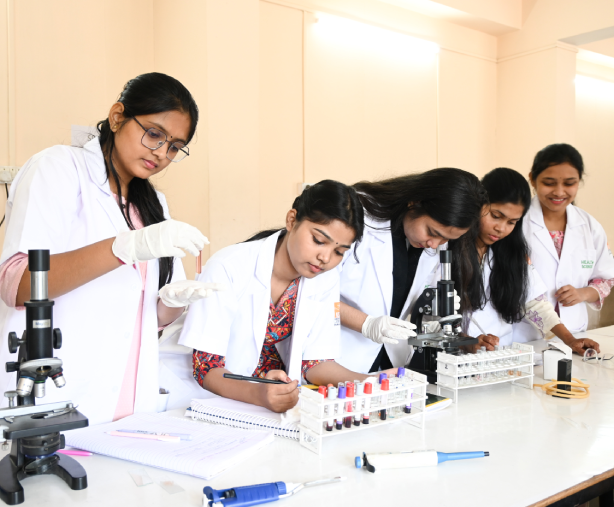
- Training: Hands-on experience with advanced laboratory instruments and clinical diagnostic techniques
- Career Roles: Laboratory Manager, Senior Medical Technologist, Quality Control Officer, Research Scientist, Clinical Laboratory Specialist
- Employment Sectors: Hospitals, Diagnostic Laboratories, Research Institutes, Pharmaceutical Companies, Public Health Laboratories
- Higher Studies & Research: Ph.D. in Medical Laboratory Technology, Biomedical Sciences, or related healthcare fields
- Key Skills Developed: Advanced diagnostic techniques, laboratory management, research methodology, analytical skills, and quality assurance in clinical laboratories
Curriculum
Semester-wise syllabus PDF
 Semester-1
Scholarship
Eligible students may also avail government and statutory scholarships as applicable. The scholarship framework at NSHM aims to promote inclusive education, academic excellence, and equal access to quality learning.
Terms and eligibility criteria apply as per institutional guidelines.
Highlights/ Advantage
-
A 2-year postgraduate programme designed to provide advanced knowledge and skills in medical laboratory diagnostics.
-
Covers specialized areas such as Clinical Biochemistry, Hematology, Microbiology, Immunology, Molecular Diagnostics, and Laboratory Management.
-
Includes extensive hands-on training in advanced diagnostic techniques and modern laboratory equipment.
-
Focuses on research, quality control, and laboratory safety protocols. Prepares students for leadership roles in clinical and diagnostic laboratories.
-
Opens opportunities for senior roles such as Laboratory Manager, Quality Control Officer, or Head of Department in hospitals and diagnostic labs.
-
Enables participation in clinical research, public health projects, and advanced diagnostics.
-
High career growth potential and demand in healthcare, pharmaceutical, and research sectors.
-
Eligibility for MSc MLT. and teaching positions in medical and paramedical colleges.
-
Enhances technical, analytical, and managerial skills, making graduates highly valuable in the medical laboratory field.
-
Contributes directly to accurate disease diagnosis and improved patient care, making it a respected and impactful career.
Teaching Pedagogies
-
01
Learner-Centric Pedagogy
The learning environment prioritizes student engagement through active learning strategies and personalized learning pathways, encouraging critical thinking and self-directed growth.
-
02
Outcome-Based Education (OBE)
Programmes are structured around clearly defined outcomes using CO–PO mapping and rubrics-based assessments, ensuring measurable learning achievements aligned with academic and industry standards.
-
03
Experiential & Applied Learning
Students gain hands-on exposure through industry expert lectures, lab- and studio-based work, and application-oriented assignments that bridge theory with practice.
-
04
Technology-Enabled Teaching
Teaching is enhanced with smart classrooms, Learning Management Systems (LMS), and advanced digital tools that promote interactive, blended, and flexible learning.
-
05
Research-Based Teaching
Students are encouraged to explore inquiry-driven learning through research projects, literature review work, and exposure to contemporary research methodologies.
-
06
Problem-Based Learning (PBL)
Real-world relevance is built through case studies and project-based learning, enabling students to solve practical problems collaboratively and creatively.
-
07
Collaborative Learning
Learning is strengthened through group tasks, teamwork, and peer assessment, fostering communication skills, leadership, and mutual learning.
-
08
Skill & Competency-Based Teaching
Alongside academics, students are trained through professional certifications, soft-skill development, and employability-focused modules to enhance career readiness.
-
09
Inclusive Teaching Practices
NSHM promotes equitable learning with bridge courses, academic support systems, and structured student mentoring to cater to diverse learner needs.
-
10
Continuous Assessment & Feedback
Student progress is monitored through assignments, quizzes, presentations, and practical evaluations, supported by timely and constructive feedback.
-
11
Community & Social Learning
Learning extends beyond the classroom through outreach programmes, community engagement, and extension activities that instill social responsibility.
-
12
Faculty Development & Pedagogy Training
Faculty members regularly participate in Faculty Development Programmes (FDPs), pedagogy training, and research workshops to ensure teaching excellence and innovation.
Scope & Career Opportunities
- Increasing demand for highly skilled laboratory professionals in hospitals, diagnostic centers, and research institutes.
- Opportunities in advanced clinical diagnostics, molecular biology, immunology, and biotechnology.
- Scope for research, quality control, and laboratory management in healthcare and pharmaceutical sectors.
- Potential to pursue Ph.D. and academic careers in medical and paramedical institutions.
- Opportunities in public health labs, forensic labs, and clinical research organizations.
- Laboratory Manager / Senior Medical Technologist
- Quality Control Officer
- Clinical Laboratory Specialist
- Research Scientist in Medical Diagnostics
- Laboratory Consultant for Hospitals and Diagnostic Centers
- Faculty / Lecturer in Medical and Paramedical Colleges
- Specialist in Molecular Diagnostics, Immunology, or Hematology
Overall, M.Sc. in MLT offers a specialized, high-demand, and rewarding career in clinical diagnostics, research, and healthcare management.
Apply Now